‘Message to the haters’: Chalmers gets cover to cut diesel tax rebate
Labor’s policy platform has been amended to give the Albanese government cover to cut the diesel fuel rebate for big miners, but a softening of the final language was welcome relief for the resources sector, farmers, builders and tourism operators.
Following a campaign in the lead-up to Labor’s 50th national conference by the highly influential Labor Environment Action Network (LEAN), convenor Louise Crawford moved an amendment that paved the way for future action.
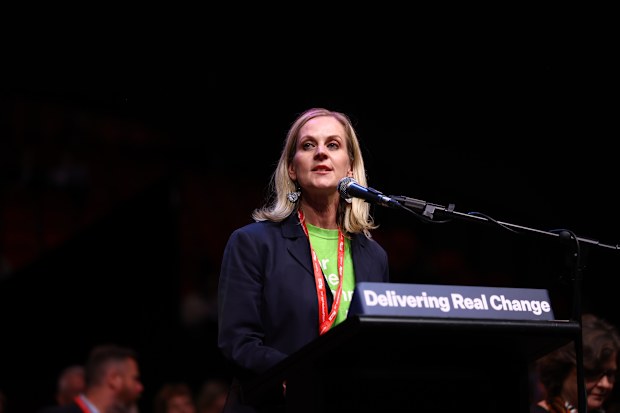
Labor Environment Action Network national co-convenor Louise Crawford. Dominic Lorrimer
“Labor will ensure that all policies, including taxation, work together to provide appropriate incentives and remove disincentives for orderly decarbonisation,” the amendment, passed unopposed by delegates, said.
The Albanese government has no immediate plans to change the diesel fuel tax rebate given the disruption caused by the Middle East war, but Labor sources speaking on condition of anonymity said the amendment gave Treasurer Jim Chalmers cover to curtail the tax concession in the future.
Crawford said the amendment spoke to the reform underlying LEAN’s campaign to cut the diesel fuel tax rebate, first reported by The Australian Financial Review.
Such a move could raise billions of dollars and come at the expense of the big miners such as BHP, Rio Tinto and Fortescue.
National conference earlier adopted a similar amendment in the draft platform that would give Chalmers leeway to impose higher taxes on gas exports in the future.
Fuel excise is imposed on diesel and petrol purchases ostensibly to pay for the cost of building and maintaining public roads. Miners and farmers can claim a rebate on their tax paid in recognition that many of the vehicles they use such as trucks and tractors do not use public roads.
The tax break will cost $10.8 billion this financial year and grow to about $13 billion by 2028-29, according to the budget papers, with just under half of that going to resources companies, including more than $1.4 billion going to iron ore miners and about $1.4 billion to coal miners.
Fuel tax credits are one of the top 20 expenditure items in the budget and forecast to grow by 20 per cent over the next four years.
The LEAN amendment was seconded by MP Sally Sitou and supported by fellow MPs Jerome Laxale and Ged Kearney, all of whom support LEAN in federal parliament.
“This is the next step in our ambitious plans to address climate change,” Sitou said.
Laxale said the amendment sent “a message to the haters that Labor can and will double down on decarbonisation”.
“Our new platform should scream that Labor are serious about climate action and no one who reads it should be surprised when we use our time in government to deliver it,” he said.
But a group called Hands Off Our Fuel, which includes mining, farming, construction and tourism sectors, criticised the connection between the rebate and lowering emissions.
“Fuel Tax Credits are not linked to decarbonisation, as they provide fair treatment for businesses that use fuel off public roads,” the group said in a statement.
Minerals Council of Australia chief executive Tania Constables said the final wording was “sensible” because the lobby group rejected a link between the rebate and decarbonisation.
Curbing the fuel tax rebate would allow the government to extract more tax from the resources sector without the political risk of a mining tax, though it is sensitive to any policies being viewed as anti-mining in Western Australia and Queensland.
LEAN is the biggest membership group in the ALP and has been a driving force behind policies such as creating a new National Environmental Protection Agency, which Labor promised at the 2022 and 2025 elections and made law late last year.
The group rallied rank-and-file support ahead of conference with hundreds of motions moved across the country seeking changes to the rebate.
It is backing a push by Andrew Forrest’s Fortescue and renewables think tank Climate Energy Finance for an annual $50 million cap on the amount of fuel credits miners can claim. A cap is also being pushed by the Australian Council of Trade Unions, which wants the cap set at $20 million.
Under the plan being advanced by LEAN, Fortescue and CEF miners would be able to claim further credits above the cap where that money was used for decarbonisation and electrification initiatives. Any money not paid out would then be put into a decarbonisation fund to benefit the entire sector.
Farmers and tourism operators would not be affected by the proposal.
Another option instead of an annual cap is allowing miners to claim only a set percentage of their annual fuel tax paid. For example, CEF estimates that BHP claimed $600 million in fuel tax credits in 2023-24; an 80 per cent cap would reduce that to $480 million.